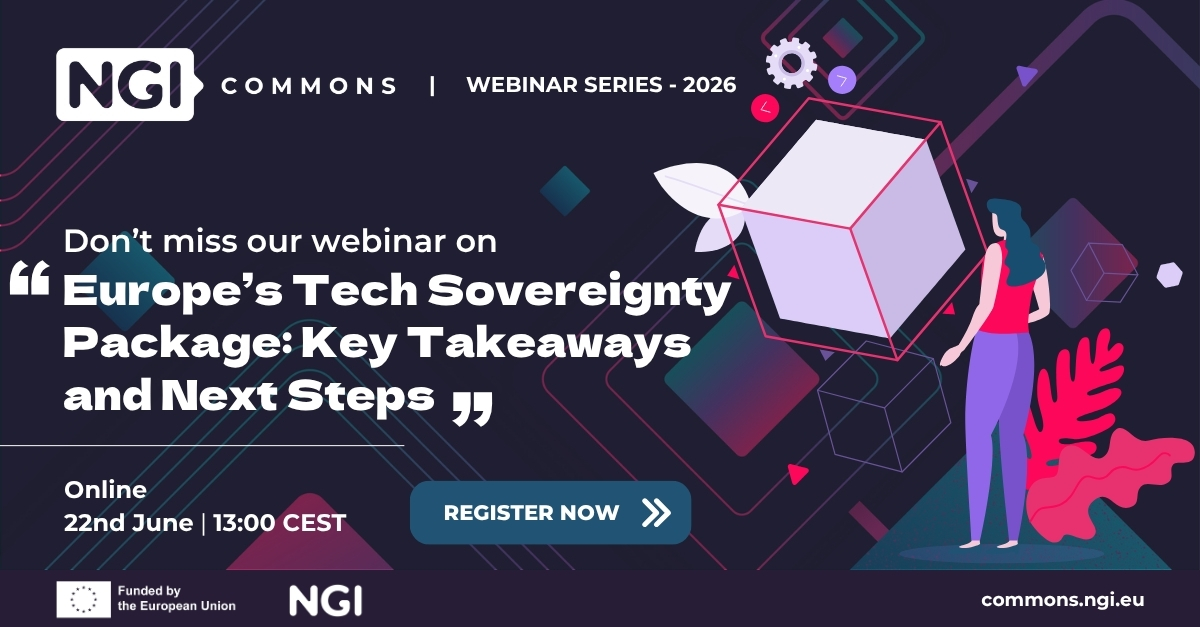
NGI Commons webinar | Europe’s Tech Sovereignty Package: Key Takeaways and Next Steps
Join us for this fifth edition of a series of webinars, which started in 2025. This one aims to provide a comprehensive overview of Europe’s Tech Sovereignty Package in 90 minutes.
As the European Union just launched its ambitious Tech Sovereignty Package in 2026, organisations across the digital ecosystem are facing a pivotal moment. This webinar offers a clear, strategic overview of what the package means in practice, cutting through policy complexity to highlight the real implications for industry, innovation, and public infrastructure.
Led by the NGI Commons project, the session explores how this framework goes beyond regulation to reshape Europe’s digital ecosystem. Rather than adding new layers of bureaucracy, the package aims to streamline existing rules while strengthening Europe’s capabilities in critical domains such as cloud computing, artificial intelligence, semiconductors, and open-source software.
The webinar will take place online on June 22nd at 13:00h - 14:30h CET.
For more info about the webinar and the agenda, please check the event page at https://commons.ngi.eu/event/europes-tech-sovereignty-package/.
The webinar will be recorded. For any questions about the event please contact commons@ngi.eu
Tickets
Additional Information
NGI Commons Webinar | Europe’s Tech Sovereignty Package: Key Takeaways and Next Steps
Event host: NGI Commons - https://commons.ngi.eu/
Event date and time: June 22nd, 2026 at 13:00h - 14:30 CEST
Event location: online
The workshop will be recorded. For any questions about the event please contact commons@ngi.eu
The information provided during registration will be used for the organisation of the event, follow-up communications and statistical purposes. Some information might be shared with third parties as outlined in the privacy statement, in accordance with the General Data Protection Regulation (GDPR).

NGI Commons is funded by EU's Horizon Europe programme under Grant Agreement No 101135279. This project is part of the NGI Initiative. This work has received funding from the Swiss State Secretariat for Education, Research and Innovation (SERI).